Cross-References
Cross-references link related elements across the pages of a project. Thanks to them you don't have to search through the drawing — just click a reference and you jump straight to where you need to be.
Wires
When two wires share the same name, they're considered connected (same potential). You set a wire's name in the Properties panel.
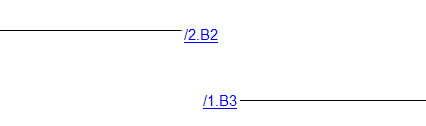
If a wire ends without a connection and another wire with the same name exists on a different page, a cross-reference to the other wire is automatically created.
A wire end pointing left or up links to previous page(s) of the project. A wire end pointing right or down links to subsequent page(s).
Symbols
A component is an electrical device that may consist of multiple symbols. For example, a relay coil (main symbol) and its contacts (subordinate symbols).
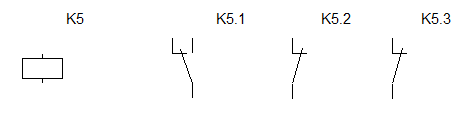
The main symbol gets a reference like K5. Subordinate symbols follow the pattern parent reference + dot + number (e.g., K5.1, K5.2). All symbols of a component share the same reference prefix.
Subordinate symbols are excluded from the bill of materials by default. To include them, check Show subordinate symbols in the bill of materials dialog.
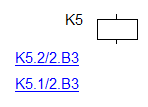
When you follow this naming convention, a reference table automatically appears beside each symbol that belongs to a component.
For example, the relay on page 1:
And its contacts on page 2:
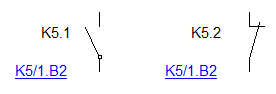
Cross-references use the format reference/page.zone, as defined by the EN 61082-1 standard, article 5.8.
Cross-reference settings
Cross-reference generation is off by default. To turn it on, go to F12 - System - Cross References.
If you move a symbol within the drawing, run Tools - Refresh cross references to update its zone.
What gets linked
- Generate cross references of symbols — references between symbols that belong together, such as a relay coil and its contacts.
- Generate cross references of wires — references on wires that continue elsewhere in the drawing.
- Generate cross references of wires also when they are on the same page — by default wire references are created between different pages only; this option enables them within a single page as well.
Reference format
Separately for symbols and for wires you pick how a reference is written. The presets combine these placeholders:
| Placeholder | Meaning |
|---|---|
{ref} | the reference of the counterpart symbol, or the name of the counterpart wire |
{po} | page number |
{pa} | short page name |
{zone} | zone from the reference grid |
The format {ref}/{pa}.{zone} produces for example -K1/L2.C3, while /{po}.{zone} gives just /2.C3.
💡 Pro tip: Formats containing {zone} only make sense when the drawing has the reference grid enabled. Without it the zone stays empty.
Why do unwanted cross-references sometimes appear?
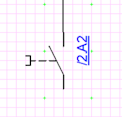
This happens when wires aren't properly attached to the symbol's connection points.
To fix this:
- a) Carefully place the wire end exactly on the symbol's connection point.
- b) If that doesn't help, redraw the wire.
